by Molly Owen | Oct 13, 2010 | Terry Blain
Music hath powers –

At one of our chapter meeting we had a workshop where we listened to music and wrote a paragraph or two in response to the music. This was a new experience for some of the members, but I’ve always listened to music as a background when I write. Mostly, I choose music to give me a feel of the time and period I’m writing.
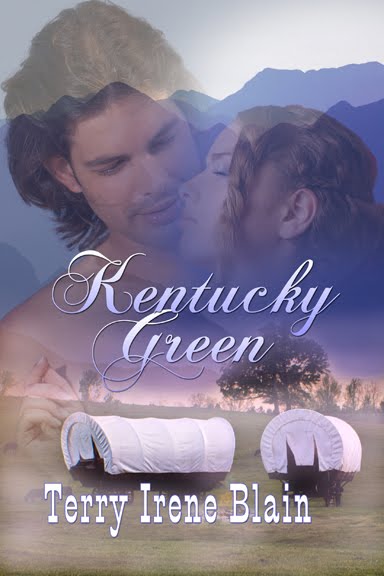
The idea is to choose music that will focus you on whatever your writing. For example, the story of KENTUCKY GREEN takes place in 1794 and involves the conflict between the Indians and the American in the what was then the Ohio Territory. The hero is part Shawnee, and much of the story takes place outside, so I had a recording (which I’ve lost) of Indian flute music that also included the sound of streams and bird songs.
 I also listened to the sound track of The Last of the Mohicans*, as the look and feel of the movie was the same as my story.
When I was doing research for writing COLORADO SILVER, COLORADO GOLD, I found a great CD. The story takes place in Durango, Colorado, and he hero of the story, who now works for Wells Fargo, grew up in a saloon. Several scenes take place in a saloon. The CD I found is Durango Saloon* 
Of course, for writing the romantic scenes, I have recordings of love songs. If there are lyrics, I tend to listen, so all the music has to be instrumental, so it just washes over me.
My current work are westerns set in Texas. And, if you’ve read my previous blog you know I love western movies*. So I have several CDs of western movie themes*.
Now, as I said, when I’m writing I can’t listen to music with lyrics. But on the way home from work, I can listen to music that will get me in the mood. Nothing like Marty Robbins* who’s most famous song is El Paso. I’ve read that his grandfather was a Texas Ranger who told him stories when Marty was a boy. And since my heroes are Texas Rangers — you get the idea.
While writing the first of three stories, one of the song lyrics gave me an idea for the next story.
 I also use several movie soundtracks as background music as I write. Gettysburg* for the epic, sweeping sounds, Quigley Down Under*, even through its set in Australia, it has that wide open spaces feeling. I like Cowboy Celtic, for the hammered dulcimer sounds.
And lest you think all I listen too is western stuff, I also used the Onigo Boingo* track of Not My Slave to represent the conflict between the hero and heroine in one of the Texas stories.
So, do you use music in your writing? How? What do you listen too?
*******
Last of the Mohicans, soundtrack, Trevor Jones and Randy Edelman
Durango Saloon, Peter Elman
The Wild West, the Essential Western Film Music Collection
Marty Robbins, #1 Cowboy, Gunfighter Ballads and Trail Songs
Cowboy Celtic, Davie Wilkie
Gettysburg, movie soundtrack, Randy Edelman
Quigley Down Under, movie soundtrack, Basil Poledoruis
Best of Boingo, Danny Elfman
by Molly Owen | Apr 13, 2009 | Terry Blain
When a History Major/Teacher Goes To The Movies.
It can be really tough when a history major/teacher goes to the movies. A basic part of going to the movies is the ‘willing suspensions of disbelief’, that is, you believe what you’re seeing. But I have trouble when I see things in the movies that I’m unwilling to accept as my BA and MA in History and BA in European Studies often get in the way.
I remember years ago when my sons went to see Braveheart and came home talking about the ‘evil English king’. I’m thinking evil English king, evil English king? Then I realize it was Edward I, who generally considered one of the great kings of England. Ok, I understand how from the Scottish perspective he’s evil. But when I saw the movie I found a lot of other problems.
First, while I believe Edward I (Patrick McGoohan) was the kind of a guy who would tip his son’s gay lover out the window, he would never send a woman, the princess Isabelle (Sophie Marceau) on a diplomatic mission. Aside from the fact that she would have been a child. Isabelle married Edward I’s son when she was 13 and this was after the execution of William Wallace (Mel Gibson).
The major battle of the movie, filmed on a wonderful big battle field rubs military/history people the wrong way – it’s the battle of Stirling Bridge. The fact the battle was fought on a bridge gave the smaller Scots army the advantage, which is why they won. Ok, it filmed better on a big battle field.
I don’t’ mind a little tweaking to make a better story, but what really bothers the history professor in me is when there’s a total lack of historical reality.
Such was the part that really bothered me is at the end, when the Princess Isabelle goes down to the dungeon to see Wallace (which wouldn’t have happened because she was child). The guard doesn’t want to let her in and she says ‘the king (Edward I) is dead’ meaning that she is now the queen as she’s married to Edward II, and the guard falls all over himself to let her in. At this point I’m trying not to yell at the screen. Everyone knew that Edward II was gay, and had no desire to please his wife. In essence, she just told the guard that she was a nobody and had no influence or authority. Aside from the fact that Wallace was executed two years before Edward I died, and before Isabella married the future Edward II.
Sorry, Mel, but Braveheart is not one of my favorite movies.
I did another double take watching Elizabeth when Elizabeth, (Cate Blanchette) already queen, is dancing with Robert Dudley (Joseph Fiennes) and she’s shocked and angry to find out he’s married. But I knew Dudley married Amy (he needed her families money) before Elizabeth became queen. And Francis Walsingham (Geoffrey Rush) only wished he had that much power and influence with Elizabeth as shown in the film.
But don’t get the idea that I don’t like ‘historical movies’. I really enjoyed Gettysburg. My girlfriend, who’s the Civil War buff, took me and then I took my family. The best part for our family was when the Union Lt. Thomas Chamberlain (C. Thomas Howell) questions some Confederate prisoners and he says “No disrespect to you brave men, but why are you fighting this war?” The Confederate prisoner answers that he’s fighting for his ‘rats’. Lt. Chamberlain is puzzled, as is most of the theater audience, and asks “your what?” But since my husband is from Oklahoma, and has a little southern accent. I could see my son’s understood ‘rats’ as ‘rights’. Oh, and any movie that has Sam Elliot (as Brig. General John Buford) is worth seeing.
Another of my favorite historical movies is Mary, Queen of Scots. I used to show this to my class and then ask them to name three things that they thought were ‘real’ and three things they thought were ‘reel’. Most often one of things listed as ‘reel’, the blood red chemise worn by Mary for her execution, but that was ‘real’ (red being the liturgical color of martyrdom). Most student got the ‘reel’ for the face to face meeting of Elizabeth (Glenda Jackson) and Mary (Vanessa Redgrave) as the film show it to be a ‘secret’ meeting.
My son took me to 300 (three hundred), where I had to keep reminding myself it was based on the graphic novel, not actual history.
It’s not that I don’t like historical movies. Some of my favorites are A Man For All Seasons, Shakespeare in Love, Last of the Mohicans, The Train, and The Longest Day. I even like 1776 where John Adams, Benjamin Franklin and Thomas Jefferson sing.
I can even enjoy a light heart historical even as I point out the inaccuracies. My favorite in this is The Mask of Zorro. While I enjoyed the movie and bought the DVD (not too tough to watch Antonio Banderas) here’s what the whispered conversation between me and my companions during the film.
Scene – the ship bringing Elena (Catherine Zeta-Jones) back to California lands in the middle of now where
Me (whispering) – why are they in the middle of nowhere? No town, pier, or anything?
Companions – shush!
Scene – where Captain Love (Matt Letscher) the American Army officer appears.
Me (whispering) – why is an American military officer acting with authority in Spanish Mexico. A military presence in a foreign county is like an invasion.
Companions – shush!
Scene – they go to the gold mine, all those cells and tunnels
Me (whispering) – they didn’t mine gold like that in California then, it was placer gold panned or washed out of stream beds.
Companions – shush!
Scene – in the fight at the mine there is a wagon load of gold bricks.
Me (whispering) – where did the gold bricks come from? There has to be a smelter to turn gold ore into bricks
Companions – shush!
Yep, life it tough when a history major goes to the movies.
So, what about you? Can you or do you have the necessary ‘willing suspension of disbelief’ when you see ‘historical’ movies? What are your favorite historical movies?
PS – sorry there are no illustrations – technical diffuculities (me) kept me from uploading.